Showing posts with label horror. Show all posts

Monday, October 23, 2017

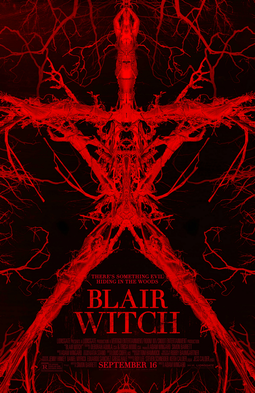
Season of the Witch: A Review of Blair Witch (2016)

         
             I finally watched director Adam Wingard’s 2016 revival of the Blair Witch franchise. I use the word “watched” loosely here, however, since I spent most of the movie looking around first a bag of SweeTarts and then, later, my phone. This might sound like high praise at first—that I was apparently so frightened of Blair Witch that I couldn’t even look at it straight on—but the whole experience ended up frustrating me more than anything. I spent most of the film looking at the screen through some sort of filter not because the actual events unfolding onscreen were genuinely frightening, but because at this point, the threat of getting jump-scared has made me second-guess every second of modern horror that I watch. There’s an argument to be made that jump scares should be accepted as a necessary and important feature of the genre; however, I would debate their ultimate usefulness at scaring an audience.

Sure, the fear of getting jumped puts you on edge, and, sure, the actual moment of the jump is frightening on an animal level since almost no one is immune to sudden loud noises, but few of these so-called “scares” have any real staying power. Oftentimes, once the jump has passed, it’s over. The viewer is released; the moment is forgotten. I don’t regard this as true horror. Jump scares have their place in the horror genre, but their overuse has, I think, become more of a deterrent to watching modern horror films. I’m highly biased in this regard, but I’m just really over jump scare-saturated horror. I tend to prefer films that instill a creeping, lingering dread or that focus their horror on specific creepy or frightening images or figures. A terrifying mood sticks with you long into the night. Films like The Babadook, It Follows, The VVitch, and, yes, The Blair Witch Project itself focus on cultivating atmosphere, and they’re all the scarier for it.

Let’s not forget that the original Blair Witch has one of the most iconic frightening images in horror cinema: At the climax of the film, the two surviving characters discover an abandoned house in the woods. They’re drawn inside by the cries of someone or something that sounds like their disappeared friend. The mad search of the house ends with the protagonist Heather racing into the basement and spotting her friend Mike standing silently, dutifully facing the far corner of the room. Heather screams and screams as she (and we) recognize the modus operandi of local legend and murderer Rustin Parr. Someone or something strikes Heather while she is screaming, silencing her and knocking the camera she’s been carrying to the ground. The film ends. Just thinking about that dimly-lit, low quality image of a man standing in a dirty basement corner while his friend screams her head off before being murdered gives me the chills. Why? Because it’s genuinely creepy, well-presented horror that doesn’t rely on any sudden loud noises to spook the audience.

The entire Blair Witch Project is a study in the measured, steady building of dread culminating in the final encounter in the abandoned house. The movie’s low budget meant that the creators had to focus on human drama and fear over flashy effects and action. Another iconic shot from the film (the one that graces the DVD case’s cover) is of a crying girl’s face—Heather, documenting what might be the last moments of her life to the audience through her camera. It’s intensely personal and raw, and it works so well in this seminal work of found footage horror because of the project’s scope and budget, the DIY spirit of the thing. The same sort of shot loses its poignancy in something like the sixth season of American Horror Story (which is itself quite good) because now we’re in the land of bigger budgets and special effects—the land occupied by the new Blair Witch.

Although the 2016 Blair Witch is positioned as a direct sequel to the first film, it feels more like a remake of the original with the budget to do the sort of things that the original might have done if it had the money. At heart, though, the story of Heather’s brother and his search for his missing sister hits all the same story beats as the original movie. There is new stuff in the mix like more body horror, an actual monster (that we see), an excruciatingly claustrophobic tunnel sequence, and some monkeying with… let’s say “time travel” with heavy air quotes. However, all of these new elements are ultimately embellishments on a plot that very closely mirrors that of the original film:

Our (larger) band fools around a bit good-naturedly before getting to the woods, and this opening includes a scene in a hotel where everyone is happy pre-frightmare. Once they’re in the woods, there’s a lot of in-group fighting, and some member(s) betray the trust of the others with regard to the group’s navigation. In the first film, Mike threw the map in the stream. This time, we find out that local volunteers Lane and Talia don’t actually know their way around the depths of the woods… after the entire group is already well and truly lost. The gang tries the sensible thing of walking in a straight line to get out but find themselves doubling back on their own trail instead. The creepy stick people show up. The piles of rocks make an appearance. One of the group members trashes the stick people and is the first to disappear. Eventually, once their numbers have been thinned out, the characters find the abandoned house in the woods, and the movie ends with our protagonist getting struck by someone or something off-screen as the camera falls to the ground and records for a few moments longer before the movie ends. This time, though, the mad dash through the house ends in the attic and not the basement. There’s more to it than that—and maybe I’m simplifying unfairly—but there’s no escaping the fact that at its core Blair Witch hits a lot of the same story beats as the earlier movie.

To give the new film some credit here, there is a suggestion that there could be some supernatural cycle at work that may be intentionally causing events to follow a similar trajectory to the first film. This comes as an actually fun, clever little reveal that happens in an understated way during the climax. The “time travel” I’m referring to very vaguely here in order to avoid unnecessary spoilers is one of the best embellishments new Blair Witch brings to the table. The tunnel scene is another good addition. It made me incredibly uncomfortable, but it was a great example of horror that will likely play on the fears of a large number of its audience members without having to resort to jump scares.

But this is still just The Blair Witch Project done flashier and without the low-budget charm of the original. It feels like they could have (and arguably should have) gotten more creative with the storytelling this time around. The aforementioned American Horror Story: Roanoke uses several different framing devices throughout its season, changing from a Dateline-style drama with the “real people” who experienced the horror narrating a re-enactment of the events performed by “actors” to a found footage horror film shot with cellphones and police body cameras to a collage of different genres (news reports, an episode of a fake paranormal investigation show, and so on) while also toying with occasional meta-commentary on itself. It does pull the Blair Witch Project card of telling the audience that such and such footage was assembled from such and such place after so and so disappeared without a trace, but that’s just one aspect of the show. It knows that just trying to sell the audience on the supposed verisimilitude of the found footage subgenre isn’t enough anymore—that the whole approach to horror filmmaking has gone stale—so it broadens the scope. Yes, this is fiction, but see how many layers of “fiction” and “fiction-pretending-to-not-be-fiction” that we can layer together using all these different lenses? The audience knows that none of this is actually real, so they have fun with it. Blair Witch 2016 still feels like it’s still trying to be Blair Witch Classic—like this is still a time when people will watch the film and be uncertain enough about whether these people are actually still alive or not to lend the whole viewing experience some extra level of dread. It needed something more to differentiate it from all the pretenders to the throne that have come out since the original film and that have, over time, caused the appearance of yet another limited point of view in a horror film filtered through yet another shaky handheld camera to be met with groans instead of excitement. There are more points of view (more babes lost in the woods equals more cameras) to use this time to construct more elaborate shots, but something more inventive like the drone camera that is very much under-utilized in the film is still missing.

The one area where this new Blair Witch matches OG Blair Witch that doesn’t feel like a shortcoming this day in age is with regard to the rawness of its performances. As viewers, we’re used to screams of supposed agony, used to seeing people supposedly fly into violent rages and lose their minds and experience all these extreme heights of emotion that we (hopefully) don’t experience ourselves. We know the screams are fake, but we buy into the emotion of the moment anyway because the approximation of what those real emotions might look like is close enough for us to pretend while we watch. Of course, one of the most well-known factoids concerning the production of The Blair Witch Project is how far everyone went to try to achieve something more real-seeming with the film: actors literally camping in the woods while being spoon-fed direction and tormented by the rest of the crew at night. I presume this wasn’t the case with Blair Witch given that this is a “proper” Hollywood film now, but the performances of distress in this movie are still very powerful. The noises that our protagonist makes at the climax of the film, as she films herself walking backwards to avoid accidentally seeing the titular Blair Witch are the sort of labored, disturbing, awful sounds you would hope to never hear coming out of a human mouth. Earlier, when the character Talia is losing her mind and jumping at shadows, she really does seem to have snapped thanks to the emotional intensity of the performance.


That rawness that I mentioned before with regard to Heather’s speech directly into the camera in the first Blair Witch is perfectly recaptured here at the film’s most emotionally-fraught moments. You feel like you’re actually watching someone come apart at the seams, which isn’t something I feel about a lot of horror films. One of the best examples of this, for me, has been and remains Tobe Hooper’s The Texas Chainsaw Massacre. The sheer amount of screaming that Sally (Marilyn Burns) does later in the film and especially during the dinner scene where the cannibal family alternatively hurls abuse and screams back at her makes one worry for her sanity. At the very end, when she’s safe in the back of the pickup truck and racing away from Leatherface, her screaming transitions quite naturally into laughter, and it’s not relief that we feel hearing her laugh—it’s dread. It’s like watching someone’s mind finally break under the strain of what they’ve endured. The new Blair Witch captures this same feeling, and I only wish that the horror responsible for the breakdowns was more inventive and more consistently, genuinely scary. It was probably unreasonable to expect a classic in the found footage horror sub-genre to return after all this time and show everyone how it’s done once more, but it’s hard to resist the poetic allure of such a narrative. Unfortunately, that isn’t what happened here. Blair Witch is serviceable—It’ll jump-scare you a bit, if nothing else—but it can’t escape the inertia of years upon years of similar films or the gravitational pull of its far groundbreaking predecessor’s achievements.

Saturday, November 21, 2015

American Horror Story: Prepare to Meet Your Maker—But Not Really


            At this point I’m off the American Horror Story bandwagon and hitching a ride back into town while said wagon rolls unsteadily, merrily onwards. During the fall of 2013, I began watching the series on Amazon at $1.99 a pop starting with the premiere of Coven. When that particular season didn’t amaze me with its opening episode (and would go on to disappoint me further), I swapped over to Asylum, and it was the show’s second season that got me. With Asylum, I fell into the “Just one more and then I’ll quit” loop. I still argue that Asylum represents the series’ high point—aliens or no aliens—because it manages to tap into the terror of institutional misuse of power: namely the fear that you can be trapped somewhere until someone else says you can leave. The truth of the matter is that both Asylum and Murder House had strong, haunted settings backing them. The former had the asylum where the main characters were stuck for most of the season, and the latter had the family home—a far from original setting but one that always resonates because of the symbolism (dissolution/dismemberment of the American family and so forth) and the suggestion that “It could happen to you too!” Coven and Freak Show had less effective settings which rarely felt dangerous or scary, and Hotel seems to have tried to remedy this problem by making its Cortez hotel its centerpiece once more. Although settings in horror films get reused a lot, setting is still an important part of the scare, and if the atmosphere isn’t oppressive—if the audience can’t feel threatened or trapped like the characters—then there’s a massive obstacle to overcome when it’s time to really turn the screws and put them on the edge of their seats. I don’t want to belabor this point, but the fact that the characters in Coven could come and go as they pleased lowered the stakes considerably.

            The biggest problem with the AHS formula, however, has been its treatment of character death. Although the spirits of deceased characters in Murder House were forever doomed to haunt a building, they were still able to behave and interact as if they were alive (albeit with serious restrictions on their ability to leave the domicile). In Coven, the magical premise allowed the writers to kill and then revive major characters several times before finally deciding to kill them for good. Freak Show even resorted to cheap “It was all a dream!” cop-out scenarios where it would show a major character dying in a gruesome fashion and then reveal that it was all just a Denis O’Hare murder fantasy. Now Hotel has vampires, and I think that point pretty much bears itself out. I’ve saved Asylum for last because, even though its aliens do intervene to revive one major character, it still feels like the show with the highest stakes where character deaths are concerned. There are no ghosts, vampires, or murder fantasies. When characters die, they don’t live on thanks to a supernatural or storytelling loophole (again, except for the occasional alien intervention).

(And it's a problem.)


           I think AHS has the Heroes problem, as it’s a show that became so enamored with its stars that it is reluctant to kill them. This isn’t a perfect comparison since AHS is an anthology series and doesn’t really carry characters from season to season, but it is a similar principle. Heroes became too fond of its major characters to kill them off. Meanwhile, AHS is too in love with its star power. For example, it was pretty much a given that Jessica Lange wasn’t going to die until the very end of each season. Kill Sarah Paulsen or Evan Peters? Perish the thought! Part of the thrill of horror films is the threat of character death, and American Horror Story has squandered that potential. It’s established a trend of saving its major players from death from the very first season, but the pattern has become especially obvious in more recent years. Every year, the show comes back with creepy trailers and opening sequences that look great but have only a tenuous, symbolic connection to the actual and atmosphere of the show. I’m fine with the way that these materials show off the motifs or themes of the season to come rather than giving away actual plot details, but I also have to admit that these short snippets have become more horrific and entertaining than AHS itself, which is more interested in being a soap opera with horror elements than a horror series with soap opera elements. Character dynamics always play a role in horror films even if the characters are easily identifiable as tropes; however, AHS seems to have mistaken its characters/actors as the real focus of a genre that really only uses and abuses them in order to accomplish its actual purpose: scaring or horrifying the audience.

            I was able to watch the premiere of Hotel on Amazon for free earlier this fall, and that’s the only episode of the season I’ve watched so far. I will undoubtedly continue to check out American Horror Story as the new seasons make their way to Netflix or Amazon, but the love affair is over. I consider myself a fan of horror movies and of the premise and potential behind a series like AHS, but unless the show manages a renaissance of sorts where it gets over its squeamishness regarding major character death, I’m unlikely to spend any more money on it. This is not to say that the series’ only problem is its considerably lowered stakes, but even the worst horror movies can at least manages this much. I’m sure there are folks who love American Horror Story for its glamorous side and because of the hype machine it still manages to be by casting Lady Gaga in a starring role, but I’m not one of those people.

Tuesday, October 13, 2015

Prometheus and the Ideology of Creation


           I’ve heard it said before that your story shouldn’t end with a punchline. If everything you’ve done only serves to prepare the reader/viewer for a single moment that retroactively justifies the entire experience, then you’ve done something wrong. 

            On some level, Prometheus is all about delivering the audience to certain “punchlines”—the big mythos-reinforcing moments where the Alien prequel calls back to the original and shows you how various disparate pieces converge to create a single chest-bursting, vent-crawling entity. To that end, the development of Prometheus’ plot can be seen as a sequence of events and set pieces all building to a particular moment: the derelict vessel-base, the mural depicting some kind of super xenomorph, the motif of the monstrous armored figure and what lies beneath its helmet, the wormlike proto-face huggers, the gross invasion of human bodies by alien species that burst out or are gruesomely extracted, the android decapitation, the arrival of yet another proto-face hunger that even behaves like its leggier counterparts, and, finally, the appearance of a baby xenomorph. 

            It's arguable that Prometheus is just checking the boxes. It’s an origin story but also one big homage. On the other hand, the fact that a film so thematically concerned with creation is itself one textual and metatextual evolution seems, if not intentional, then at least very convenient. We see the xenomorph physiology and reproductive system evolve. Likewise, we see Prometheus evolve into Alien. How do we get from big, pale, totally ripped giants drinking black liquid that tears apart their DNA to the events of the first Alien? Prometheus is here to show you.

Wikipedia. Wikimedia Foundation, 27 May 2012. Web. 13 Oct. 2015.
            Like Alien, Prometheus has an interest in a strong, female lead. (Check off another box on the homage list.) However, unlike Alien, this film puts that lead through a not particularly inventive kind of hell. Noomi Rapace’s Shaw is barren—a fact that we learn moments before she and her colleague have sex and she gets pregnant… with a horrible alien fetus that she is forced to remove in a scene so horrific it makes the ostensibly horrific stuff that follows look like nothing by comparison. There’s something of the torture porn genre in Prometheus.[1] Shaw is impregnated thanks to the machinations of the android David who infects her lover with the Engineer’s black liquid; she’s forced to mutilate herself to remove the fetus, gets roughly stitched back together, and then spends the rest of the movie running and getting knocked around in ways that would almost certainly tear the wound open again. If she’s not doubled over in pain, she’s heaving and breathing heavily.

            Shaw is our “Final Girl,” of course, and like Ripley she’s destined to survive the encounter with the Engineers, but there’s something almost mean-spirited about the rough treatment she receives, particularly with the emphasis on monstrous pregnancies that so many other horror/thriller films have already drawn on (see Rosemary’s Baby for a seminal example of the trope).[2] The original Alien played off the creature’s unique physiology and reproductive methods to comment on a male fear of penetration (and possibly on the fear of the body being destroyed from the inside out by cancer or Crohn’s Disease). Prometheus isn’t that inventive. Instead, it focuses on the female body as a symbol of the power of creation, which is an idea even older and more worn than that of the monstrous pregnancy. 

            Anybody can create life, jokes the doomed Dr. Holloway.

            Not me, replies Shaw, tearfully.

            Thematically, the nature or purpose of creation is Prometheus’ chief concern. Its title recalls the noble mythological sacrifice of the Titan who brought fire to humanity and was punished for it. If not strictly a creator, Prometheus was at least a benefactor and arguably the figure, mythologically-speaking, who sparked humankind’s development by giving them something that enabled them to reach their full potential. The Prometheus of the film might be the Engineer race, who apparently descended from the heavens to help develop mankind in some unexplained fashion, but it’s also the ship that bears the name (as well as Shaw and company). The hope of the owner of the Weyland Corporation that funds the voyage is that the vessel will return to earth with the secrets of creation and of life and death: a new “fire” that could further fuel the development of humankind. The question that emerges as the film’s plot developments, however, is whether or not human development isn’t a double-edged sword. 

            We’ve seen this particular issue born out in sci-fi stories elsewhere. The main antagonists of the Mass Effect videogame series are monstrous “Reapers” that cleanse the galaxy of all life whenever technology reaches a certain peak. In Prometheus, the creators are also the destroyers. The Engineers created humanity but seemingly plan to destroy it. Prometheus is supposed to bring back the “fire” but just sets off a chain reaction that results in the creation of a new threat to all life. Was the Titan humanity’s savior by virtue of his gift, or was he ignoble in that the gift was a curse? After all, with our fire, we’ve gone from simply warming ourselves and cooking food to survive to polluting the planet and finding new ways to kill one another. Prometheus doesn’t provide an answer to this question because it never explains why the Engineers want to destroy humanity. Either this was a serious omission or the writers want viewers to think of our creators as capricious like Holloway suggests in his conversation with David. 

            We humans made androids because we could, says Holloway, to which David replies by arguing that humans would be devastated to learn that their creators did much the same thing on a whim. This is the closest thing to an answer to the gift-curse question at the heart of the film that the story offers: that “fire”/life is neither gift nor curse—it was simply something for Prometheus or the gods or Engineers to do when they were bored. Human life was a lark, and stamping it out would likewise be nothing more than something to do. It is a pessimistic outlook.

            Of course, Holloway is also wrong about David. Presumably androids serve important roles during space travel because of their relative immortality and the fact that they require fewer resources to operate while the rest of the crews is in stasis. It is equally unlikely that such a creation was built only on a whim. Furthermore, androids are superior to humans in many obvious ways—stronger, more durable, and with greater mental faculties. Even David’s supposed emotionlessness may not be strictly true. After all, in addition to admitting that he was afraid for Shaw during the final confrontation with the last Engineer, David’s treatment of Holloway also suggests that he can experience feelings like resentment. Having been the object of low-level resentment and mistrust throughout the mission, David’s decision to “poison” the scientist with the Engineer’s black liquid feels both coldly scientific and not quite impersonal. He even makes a point of asking Holloway to what length he would go to make the mission a success, thereby manipulating him into saying exactly what he knows he would (that he would do anything for the cause) so that he can justify poisoning him. David doesn’t need the justification, but his duping Holloway represents a bit of spiteful fun on his part. We appreciate  the dramatic irony of the question and what it entails and so does David. 

            David’s very existence and the parallel the film draws between his relationship with his creators and the humans’ with theirs, including the disappointment that comes with knowing the Engineers are all too mortal, calls into question the mythological importance of creators. David is superior to his creators, and humanity might likewise be superior to their own. After all, in addition to sharing the same DNA as their creations, the Engineers are also not immortal and may very well have their own questions about their origins. 

            Although we are told by Janek that the Engineer structures on the planet are a military installation and that the black liquid is a weapon, the evidence on display in the film suggests otherwise. Beyond their prodigious strength, the Engineers do not seem to be equipped with any weaponry. Their vessel is likewise unarmed except for the hold filled with deadly canisters. If it were otherwise, and the ship beneath the dome was military, why not eliminate the Prometheus after taking off to prevent pursuit and start the human genocide early? What goes unstated in the film is the possibility that the Engineers who were on the planet were scientists like Holloway and Shaw. The canister shrine room in particular suggests that the Engineers are scientists who have married technology and theology—at least, one might make that assumption based on the ritualistic arrangement of the canisters before the aforementioned xenomorph engraving and a massive stone idol head (which does resemble an Engineer and might suggest that they are self-worshipping, not unlike humans who like to render God as a man). Since the humans and Engineers are otherwise frequently paralleled with one another, this reading of the latter as scientists who have resolved in their culture the age-old debate between science and faith seems highly probable given that Shaw is doing much the same thing, personally and in her relationship with the less spiritual Holloway.

            Also, who is to say that the black liquid is actually a weapon? It could certainly easily be weaponized, but reading it as only a weapon of mass destruction requires assuming that the Engineers view life and death the same as humans do. The very first scene in the film suggests that they don’t. The ritual suicide of the otherwise seemingly healthy Engineer is presented largely without context; however, the act and its aftermath tells us a lot about the Engineers’ outlook on life and death and how it ties in with the black liquid. The Engineer willingly gives up his life to produce something new. His body and DNA break down, but the remains are repurposed rather than outright destroyed. Although the Engineers are certainly not without a sense of self-preservation, which is obvious during the sequence where the holograms are shown fleeing within the bowels of the dome, they may view self-sacrifice for the greater good or to further the development of life in the universe as necessary and not evil. Like the mythical Prometheus, the cost of advancing civilization is great personal pain. The idea that the Engineers might view humanity’s mass destruction as another step toward further growth is floated at least once in the movie, and based on the aforementioned visual evidence, the idea seems likely. The Engineers might have been hell-bent on wiping out humans, but the act likely wasn’t one they would see as evil. They would instead be creating new life from all that death.

             The Engineers might actually see themselves as Promethean, delivering to humanity the source of further evolution and development that Weyland is seeking. Ironically, though, the life it would deliver would mean the death of the individual who seeks, greedily, to preserve his own existence. The alien of Alien is an apex predator that results from the mass death of Prometheus. It’s the punchline of the film but also its literal and thematic culmination, suggesting that it may be the next step in Engineer-human evolution and therefore a superior being much like David is. To create is to risk being upstaged by the offspring, and to be a creator is to be outmoded, if not outright destroyed by the next generation.      

*

             Prometheus is a great sci-fi film. The futurism of the technology and the backdrop of deep space only serve as the icing on the thematic cake. This is a film concerned with deep-rooted questions regarding the ideology of creation and of humankind’s place in the universe. As someone with a religious background, I find the issues Prometheus interrogates especially salient. There are a lot of bad Christian movies out there: God’s Not Dead, 90 Minutes in Heaven, War Room. Stuff like Billy Graham’s The Homecoming (which I grew up with) has always existed on the periphery of the major movie business, which used to use “spiritual” stories like The Ten Commandments as an excuse to hype up the violence and sexuality of the film without censure. The new wave of theatrical Christian releases, however, is more dogmatic than ever—concerned less with thematically rich narratives and more with (literally) preaching to the choir. Ridley Scott’s own Exodus: Gods and Kings was so bland and uninventive that it’s hard to imagine the Christian it could offend.

             Meanwhile, films that explore Christian themes or stories that aren’t particularly dogmatic or traditional in their approach, such as Darren Aronofsky’s Noah, are lambasted by Christian audiences for taking liberties with the Biblical source material—while it’s apparently ok to tell viewers that college professors are out to force students into becoming atheists and that victims of domestic abuse just need to try harder to be faithful to God rather than seeking real world counseling or leaving a dangerous situation. I’m sure that it offends some Christian viewers, but Prometheus is a film with an interest in faith beyond how one’s particular beliefs explain creation alone. Although belief in a specific creator (or creators) of the universe is not unique to Christianity, in the western world, it’s not hard to see Prometheus as a largely Christian film, especially given the way that human beings are fundamentally (at the genetic level) created in their makers’ image. What the film has to say about faith specifically isn’t entirely negative or ambivalent either.

            Prometheus implies that Shaw is a Christian, and she maintains that belief through everything that happens to her. While Holloway is quick to give up hope when the Engineers are seemingly all dead, Shaw continues to believe that there are still answers to be learned from them, though they may be physically absent. Furthermore, the question of who created the Engineers is also raised, so while Prometheus might be blasphemous for suggesting that God didn’t directly create humankind, it doesn’t entirely rule out the possibility that there wasn’t a divine hand involved. Since the Engineers are human on a genetic level, one extension of this revelation in the film’s universe is the possibility that the Engineers are the first humans created by God and we’re they’re “offspring.” The movie does question whether there is an afterlife or not, since the dying Weyland claims that there “is nothing,” presumably on the other side—a fact which the decapitated David seconds, though his agreement is not proof positive that Prometheus does not believe in an afterlife since David is, after all, is nothing if not duplicitous. Weyland himself is not religious in the traditional sense. Since this is the film’s final word on the subject, however, after young Shaw is seen posing the question of where people go when they die to her father in a flashback earlier in the movie, it’s not altogether impossible that it is suggesting that there is no divine hand involved, and if the Engineers aren’t the source of all life, then they themselves sprang from mortal origins.

            The point that I’m trying to make here is that Prometheus is a better “Christian” film—especially insofar as it tackles some big questions and themes relevant to that faith—than other movies that are explicitly marketed as such. Of course, this is my personal opinion, and my opinions trend more secular and liberal than many Christians would abide. The financial successes of films like the ones I mentioned before is proof positive that this super conservatism still exists. I think Prometheus is a good film for Christians who are interested in asking questions and entertaining “what if”/alternate universe explanations for the stories they’ve heard so many times before. It doesn’t serve as an echo chamber, though, and that seems to be what a lot of Christian films do—provide an experience that doesn’t question or even do much at all with the interesting ideas offered by the faith. There are no challenges to face or obstacles to overcome there. These movies are celebrations of a particular mindset and don’t demand anything of the viewer other than that they also celebrate that mindset. Prometheus is in its own way far from revelatory, though, and the nihilistic nastiness and quasi-misogyny lurking in its heart are nothing new.  

            Additionally, I’m not sure there isn’t something transmisogynistic about the portrayal of Charlize Theron’s Vickers. We learn that she is Weyland’s child, but he is apparently not pleased with her. In his fake will he describes David as the son he never had. Now, either Weyland is simply expressing his displeasure at having a daughter (an Assigned Female At Birth daughter), or he may be implying that Vickers is trans. She is depicted as a strong or even masculine figure (we first meet her as she’s doing push-ups, for example), and Janek asks her at one point if she is a robot—questioning her humanity but also, by extension, her realness. Possibly her womanhood. Consider also that when Shaw attempts to use Vickers’ medical equipment to extract the alien fetus that the machine explains it is “calibrated” to only treat men. There are other explanations for these weird beats, of course, but a reading of Prometheus as rather typically transmisogynistic (on top of every other typical thing it does) is still possible and very bothersome. 

            The box art and menus for the DVD emphasize three characters: David, Shaw, and Vickers. Vickers and Shaw both survive longer than any other human character in the story, but neither is treated very well. Shaw gets put through the wringer, and Vickers lives because she’s a coward. We are shown her antagonism early on when we learn she doesn’t share Shaw and Holloway’s faith. She’s a bureaucratic presence who refuses to let the wide-eyed scientist believers make contact with any intelligent life they might meet. She constantly wrests authority from the easy-going, likeable Janek. She’s designed to be unlikeable, and the possibility that she might also be trans means Prometheus, like so many other films, has nothing new to say about trans people either, suggesting instead that they are fake, duplicitous, inhuman, etc. Unlike Charlize Theron’s wonderful turn as Furiosa in this year’s Mad Max: Fury Road, the woman she plays here is less obviously a figure worth praising. Prometheus might feature two of its three (only three) female characters prominently and might cast itself as some kind of pseudo-feminist narrative by having Shaw survive, but its treatment of them—especially of Vickers—is questionable.

            After seeing Prometheus, I have since read a lot criticism levelled against it. More than anything, a lot of people have pointed out the illogical or just outright bad decisions made by supposedly intelligent people in the film as annoying typical. I’ve felt for a while now that most horror movies take place in alternate universes where for some reason the genre does not exist, and Prometheus must occupy a similar space. I can see the flaws now; however, when I was first watching it, I was very much swept up in the film and its mythology. It may hit a lot of familiar notes (some more problematic than others), but it’s also a film that seems to be greater than the sum of its parts. That it made me think about its themes at all is admirable, and I personally find it well-paced and beautiful. CG landscapes always look dead to me anyway—Disney’s attempts to create a sense of wonder with them in Alice in Wonderland and Oz the Great and Powerful have been laughably bad—so the stuff in Prometheus actually looks good because of how devoid of life it generally is. And that’s just another metatextual element that enforces the theme of the movie: From death comes new life. Of course, as a human being living a finite, fragile existence in a dangerous world (see the number of deaths by gun that have occurred in this particular country this year alone), that’s also a hard message to stomach.

Notes:

[1] According to Urban Dictionary “torture porn” is “[a] term coined by various critics which discusses the current trend in horror Hollywood which consists of horror movies having no story whatsoever but gratuitous images of people having random body parts removed. . . .” (http://www.urbandictionary.com/define.php?term=torture+porn). In essence, films like Saw and Hostel qualify as torture porn because of their heavy reliance on body horror—on creating a sense of unease, horror, or disgust by deforming, mutilating, or deconstructing the human body. The drawn out manner in which the removal of the alien fetus from Shaw’s abdomen is conducted feels reminiscent of this sub-genre of horror.

[2] The “Final Girl” is the female character in a horror film who is usually the one to confront and defeat the killer or monster in the end. Though her survival is not always guaranteed, she will last the longest, and according to TV Tropes, “[e]specially in older works, she’ll also almost certainly be a virgin, remain fully clothed, avoid Death by Sex, and probably won’t drink alcohol, smoke tobacco, or take drugs” (http://tvtropes.org/pmwiki/pmwiki.php/Main/FinalGirl).  Joss Whedon’s The Cabin in the Woods plays with this horror trope by building an entire mythology around the fact that characters in horror movies always fill certain roles (of which the Final Girl is only one; another is the stereotypical “stoner”), and Carol J. Clover’s book Men, Women, and Chainsaws examines issues of gender and identification in horror films by suggesting that male viewers actually root for and identity with the Final Girl rather than the murderous, rampaging monster or killer (the ostensible source of their interest in the film).   

Wednesday, August 5, 2015

It Follows (You)

           It Follows is a movie that understands the importance of tension in a good horror film. It’s also a horror movie with a soundtrack so unnerving that it’s frightening to listen to all on its own without the visual context provided by the movie. Disasterpeace’s score is an at times disjointed symphony of discordant noise that builds and ebbs with the action on screen, baiting listeners with periods of quiet that only make you anticipate (and fear) the next jump. Never have I encountered music that so perfectly mirrors the rhythm of a horror film. Like It Follows itself, the soundtrack teases you. Although neither resorts to jump scares often, they both take advantage of the fact that we’re a culture accustomed to them, and they constantly trick you into waiting for a bang that doesn’t come. If there’s going to be a next period in horror, this may very well be it. Jump scares have become so prevalent that a post-jump scare horror culture has to monopolize on it to create new levels of uncertainty and tension without becoming exploitative. Like The Babadook, It Follows is a horror film from which other horror films could learn a thing or two—and not just about how to ration and effectively using jump scares, but also how to use space.

            Horror movies depend upon effectively controlling space. Deliberately restricting the viewpoint of the audience by blocking off areas to the back or side of a character in an uncertain situation, using their body or a door or other obstruction, is old hat by now. We know that we’re being purposefully toyed with and forced to anticipate both what occupies the hidden space and the exact moment that it will be revealed to us (and in what manner and with what aural stinger). The found footage sub-genre of horror that has thoroughly saturated the market at this point is a prime example of space control. It not only forces the viewer into a closer relationship with the events they’re witnessing through a first person perspective but also puts blinders on them and deprives them of the real world “sixth sense” and peripheral vision that would make sensing danger easier. Instead, their senses are restricted only to the visual and the auditory, and the space they can perceive is incredibly limited.

            Restrictive close-ups of faces, frenzied camera jiggling, and quick cuts are all ways that horror movies toy with space and force the viewer into a position of uncertainty; however, David Robert Mitchell makes the wise decision in It Follows to break free from the obvious claustrophobia of close quarters and to instead use more wide angle shots. The old standbys are still present, but It Follows makes good use of the larger world to create more complex spaces that still feel dangerous. There are multiple scenes that focus on the decrepitude of a Detroit neighborhood, for example. By breaking out into a larger world, Mitchell only increases the tension for the viewer because of the nature of the beast at the heart of It Follows. The titular “it” could be anywhere at any given time and could look like anyone. By giving the viewer more space to observe the action, the film also exposes them more thoroughly. Rather than immediately knowing that the threat is behind the characters or off to the side behind a convenient door, the audience is forced to search for and attempt to identify the monster in crowds or in wooded areas. It’s a twisted game of “Where’s Waldo?” that only gets more fiendish when the film switches perspectives to a character that cannot actually see the thing at all. Sometimes it’s easy to identify the antagonist because of its form or because a shot is designed to highlight its presence, but the use of wide open spaces still works effectively as a scare tactic because even if we can’t immediately see the creature, we anticipate its return, and it could be lurking anywhere in the fore-, middle-, or background of any of It Follows’ wider, more open spaces.

            That It Follows is meant to be macabre game of sorts for viewers makes sense given the way that the rules are so handily dispensed by the protagonist Jay’s “boyfriend” Hugh/Jeff, who tells us everything we ever learn about the monster/creature/thing at two points during the film. It’s very convenient and perhaps a bit heavy-handed, but plenty is still left unsaid about the actual nature of the beast. Also, I just so happen to find the rules by which the creature plays spine-tinglingly excellent. Rather than appearing from thin air to shock us repeatedly, the monster has to walk to get to its victims; however, it is always walking straight for them, and it is constantly aware of where they are. It doesn’t speak or rest, and apart from one startling scream during an encounter in a boat house, it never communicates in any way apart from knocking on doors and moving ever closer to its target.

            We learn these facts about the creature early on, and as I previously suggested, it serves the important purpose of making the audience constantly look out for it. Although it can jump out at people, it’s far more common to see it approaching first, and the fear the monster generates has less to do with its appearance than it does with its inexorable nature and the knowledge that if you aren’t seeing it, it’s either en route to you or somewhere you haven’t looked yet. At one point, Jay and friends pull out of her driveway in the car, and as they’re driving away we see a naked man standing on the roof watching them. The implication, of course, is that “it” was literally right on top of them for some time before they left. The viewer must then re-contextualize the previous scenes with the new knowledge that the creature was there all along.

            Moments like this one that force audiences to imagine what they cannot see or are not shown employ what the Gothic writer Ann Radcliffe termed “terror”—a concept apart and different from horror. In her essay “On the Supernatural in Poetry,” Radcliffe distinguishes between terror and horror thusly: “Terror and horror are so far opposite, that the first expands the soul, and awakens the faculties to a higher degree of life; the other contracts, freezes and nearly annihilates them . . . and where lies the great difference between horror and terror, but in . . . uncertainty and obscurity.”[1] Terror, Radcliffe argues, forces the reader (or viewer) to exercise his or her imagination. In this regard, uncertainty or obscurity can be used to more effectively frighten people by making them fill in the gaps themselves. Conversely, horror is simply showing someone something horrific outright. It’s shocking, but “in real life . . . to ascertain the object of our terror, is frequently to acquire the means of escaping it.”[2] In essence, a sense of horror is a fleeting thing. It causes a shock, but once it has revealed itself, it’s often possible to escape from it. Literally, you could say that seeing the monster’s location makes it easier to evade (in some cases). Metaphorically, however, escape comes in the form of a release from tension. Fear is more lasting, then, if people are forced to consider uncertain or obscure elements because without a definitive answer they must turn to their imaginations and a myriad possibilities that are likely more frightening than anything the writer or filmmaker could come up with.

            A good scary movie, in my opinion, uses both terror and horror throughout. They can both be frightening when properly employed, but the use of horror can also turn an otherwise good movie on its head. I usually offer up The Conjuring as an example here. The largely unseen entity is well used for the first two acts of the movie, but when it becomes embodied exclusively in the third and the film devolves into a laughably typical exorcism plot I stopped being afraid and started laughing. The distinction between terror and horror is an imperfect one, though, and while Radcliffe was arguing for the superiority of terror, I believe both have their place. It’s difficult to say what “ratio” of the two is appropriate in general, but I think It Follows specifically does a good job balancing the two. It begins with a tense scene of uncertainty where a girl flees an unknown threat (terror as we struggle to understand what’s going on), then offers up the sight of her mutilated body on the beach (horror as we behold the gore) before settling into a lengthy build-up focused on the protagonist Jay, her friends, and her relationship with Hugh/Jeff (terror as we wait to find out how this story connects to what we’ve already seen).

            Wisely, It Follows ends with terror rather than horror by leaving the fate of the monster uncertain, much of its nature completely undisclosed, and the day-to-day happiness of Jay and Paul in question. Rather than ending with a cheap bang (I’m looking at you, Sinister), It Follows concludes with more uncertainty. The out of focus figure walking behind Jay and Paul might be an ordinary pedestrian, or it might be something else. The screen then cuts to black and to the title “It Follows,” which could be read as an answer to the question of the creature’s survival but also serves as a reminder to the audience—It’s still out there (maybe), we still don’t know what it is or whether it can be killed, and you might very well be next. Rather than granting the audience release, It Follows only offers more tension. It’s a quiet but menacing farewell that wants the audience to stay engaged and to keep imagining as they exit the theater. There’s even a scene in the movie where Jay and Hugh/Jeff go to the movies and encounter “it.” It makes you want to look around at the other people with you there in the dark. It makes you only want to open your door to a knock if it’s accompanied by a familiar voice, and even then you still might find an unwelcome guest crowding into the room behind your pal.

            By all accounts, Mitchell is well aware of the importance of uncertainty to the film. In an interview, he says, “I’m not personally that interested in where ‘it’ comes from. To me, it’s dream logic in the sense that they’re in a nightmare, and when you’re in a nightmare there’s no solving the nightmare. Even if you try to solve it.”[3] Apparently there are rumors of a sequel exploring the origin of “it,” and I cringe at the thought because I know that they’ll inevitably go to the well of demons and spirits that Hollywood keeps dredging from and offer a disappointing, canonical (definitive) answer to a question that doesn’t require one. It puts me in mind of something my Cultural Studies professor once said about the comic book industry—namely that art tends to succeed in spite of the industry rather than because of it. The very notion of “industry,” of course, is industrialized, calling to mind conveyor belt assemblage, mass production, and capitalist money-mindedness. It’s the antithesis of art, and although one can defend the move to capitalize on a profitable idea as logical, it still doesn’t make it right.

            There’s nothing especially frightening about learning that “it” is just another demonic presence lurching after people. What is frightening is a monster that defies explanation. Without an answer from the filmmakers, we can only guess at what “it” is and what “it” means, and we’re likely to continually cycle through the possibilities in a manner that recalls the creature’s own shapeshifting. It’s more threatening this way because its identity is uncertain and because that uncertainty allows it to defy the schema by which we qualify, compartmentalize, and usually put away horrific things. It recalls a Lovecraftian universe in which there are things that simply defy human understanding. Fans of the Hannibal Lecter novels and films were disappointed by the origin story on offer in Hannibal Rising because its explanation of Hannibal reduced his inscrutable quality (his intelligence and his brutality) to something known and trite.

            Not everyone has my imagination, though, and the mixed viewer reviews—with people despising It Follows for not being scary and others giving it more credit than it deserves—suggest that people either really like the focus on uncertainty or feel short-changed by it (and/or the obvious allegory between sexuality, disease, and a monster that cannot be stopped and can only ever be temporarily evaded, surrendered to, or passed along to some new innocent). “Generally speaking,” writes Peter Debruge for Variety, “horror is only as potent as whatever fear it exploits, and ‘It Follows’ relies a bit too heavily on a wobbly venereal-disease allegory.”[4] Arguably It Follows does have other thematic interests, however. Specifically, the film focuses on morality and the fear of death, the latter of which is inevitable and often impossible to recognize in advance. The movie incorporates passages from T. S. Eliot’s “The Love Song of J. Alfred Prufrock” and a couple quotes from Fyodor Dostoevsky’s The Idiot. Clearly It Follows has aspirations beyond simply invoking the classic horror films of the seventies and eighties with its period piece look, music, and poster design. John Carpenter’s The Thing is a clear inspiration for the creature, but there are also bits of music that sound somewhat familiar. To my ear, there is a little of the Halloween theme in It Follows’ “Detroit,” for example.

It Follows' poster has a certain "retro" quality.[5]

            It Follows might seem to be somewhat hamstrung thematically by associating its monster with sexual disease, but it also feels like an appropriate, self-conscious literalization of a theme that underlies many more traditional slasher movies like Friday the Thirteenth. I wrote the following post on the subject on Tumblr a while back:

“It’s pretty clear that the Friday the 13th films embody the duality of Americans’ fascination/repulsion regarding sexuality–the heavy-breathing voyeurism, on one hand, and the deeply-ingrained puritanical desire to stifle (or shame, etc.) on the other. Viewers are able to enjoy the creepy, peeking camera and then experience the catharsis of seeing Jason murder (in first person, no less) the objects of their misbegotten desire. They are able to project their guilt over their desire (their subconscious sense of their own perversity) onto Jason as he violently annihilates the erotic tableau that has caused them so much confusion. The films are essentially torture porn for the guilty consciousness of a nation that continues to insist ‘she was asking for it’ and to simultaneously emulate (even worship) and vilify the perceived amoral virility of youth culture.”[6]

Horror films have often linked sexuality and the subsequent murder of characters. It Follows might appear to be stating the obvious by making things so explicit, but it feels like a long overdue open acknowledgement of the way that we like to associate youthful promiscuity and experimentation with extermination. While there is some sense that “Mitchell creates a situation where the infected are super-motivated to pass it on,” it also highlights the importance of the disclosure of health issues for prospective sexual partners.[7] Consent requires knowing what you’re getting into, and a reading of It Follows as symbolic of a rampant serial infection like AIDS thanks to unprotected sex (or sex with strangers) works as well. A culture that is complicit with these behaviors is a culture stalked by a monster that could easily come almost anyone’s way.

            Furthermore, although the disease angle is certainly a valid interpretation of the film’s events, the plot also deals with issues of morality. Jay and the other bearers of the curse have a difficult choice to make when faced with the fact that they are marked for death. The seemingly right thing to do is to either try to outrun the monster forever or to surrender to the inevitable and die without passing it on and hurting someone else. Of course, surrendering isn’t necessarily the moral thing to do since your own death only sends the monster to the next person in line. They might be a scumbag who knowingly tricked someone else into taking on the curse, or they could be a complete innocent who didn’t know what they had or what they were doing. By passing the curse on, you can prolong your own life in addition to the lives of those before you in the chain, though you are also likely committing a heinous immoral offense if you trick someone else into taking on the curse. The least selfish action seems to be to run and to keep running as long as possible. You guarantee your own suffering but postpone that of the other folks in line and do not curse others; however, any good you do (even by staying alive as long as possible without further spreading the curse) only postpones rather than eliminates the harm that will eventually come to other people. Again, It Follows refuses to give easy answers, and with the unnamed girl in the opening, Jay, and Hugh/Jeff it offers a poignant depiction of the madness and amorality that come from trying to solve the unsolvable quandary.

            Similarly, It Follows examines the ambiguity of human sexuality and the cultural baggage with which it is saddled. After having sex with Hugh/Jeff, Jay ruminates on her growth from girl into young woman. She talks about her dreams of holding hands and sitting in a car—not to go places necessarily but just to be there—and it all sounds very much like how we tend to paint love, sex, and monogamy in idealistic terms. You could argue that It Follows is an anti-premarital sex PSA that uses the scare tactics of rampant, inescapable, deadly disease and the fact that a single sexual encounter essentially forces Jay into several others to suggest that sex outside of marriage cheapens the experience of relationships with other people. The evidence is all there to back up such a reading, but I think it is ultimately undermined by the aforementioned reflections by Jay herself who, after recalling her childlike interest in relationships, asks Hugh/Jeff (and likely herself), “But where do we go now?”

            These musings are accompanied by shots of Jay toying with a plant growing from the asphalt beside Hugh/Jeff’s parked car. In a sense, the plant symbolizes Jay’s romantic development. Born and raised in soil, she has blossomed to find a world of asphalt and dilapidated buildings. She lives on the edge of Detroit, a city with a sense of rampant decay in the film. Literally, Jay has to wonder where she goes from her comfortable suburb when the world outside it seems to be on the downslope. Symbolically (metaphorically), she has found that the idealism of sex that she grew up with has no foundation in reality. There’s nothing to it really. It is what it is: underwhelming and bereft of arcane meaning. Reality fails to live up to expectation. You could argue that this sense of directionless (“But where do we go now?” From here; from sex) actually reinforces the PSA reading, but at no point does It Follows suggest that waiting or marriage are better answers. Parents are sorely lacking in the film almost to the point of stretching believability, but what parents we do meet are not happily married either. Jay has only her mother, and several shots focus on the father in photographs that is clearly missing from the family’s current living situation. Greg seems to only have a mother as well. Hugh/Jeff also has a single parent. At least, these are the only parents we hear about or see. If It Follows is a critique of premarital sex, then it’s missing half the message. If it’s a critique of the idealization of sex, though, the message comes through loud and clear. Love doesn’t exist. Sex is still a Big Deal in the film because of the monster that comes with it, but the actual act is meaningless.

            It Follows’ plot is almost cruel in its efforts to make Jay see this meaninglessness. She has sex with one man who lies to her about his identity and his reasons for being with her in the first place. She has sex with another man who doesn’t believe that her problems are real to try to solve those problems, and when he dies, she may or may not have had sex with multiple strangers at once to try to save her life. She finds herself increasingly alienated from her romantic notions of love and sex, and when she finally thinks she can find a measure of that old idealism with her longtime friend Paul, she only finds more of the same nothing.

            Paul himself is an insufferable “good guy”—the “friendzoned” gentleman, the pencil-necked “beta male” who deserves the girl but can’t get her because she only likes “jerks.” He’s the worst part of a superficial reading of It Follows because of how he seems to vindicate that sort of “good guy” myth. He eventually gets the girl, after all. And yet, Paul also finds that sex with Jay is not what he thought it would be. Afterward, they ask one another if they feel any different. The obvious implication of this question is that they are trying to determine if the creature is still alive (if Jay now feels less cursed while Paul feels a sense of foreboding); additionally, though, the question is about the sex itself and their relationship. Does Jay feel better now that she’s been with this “good guy” who risked his life to save her? Does Paul feel better now that he’s been with Jay? Neither feels any different. It’s just more sex. We see them holding hands in the final scene of the film, but neither one looks happy. On the one hand, there is still the potential supernatural threat: The camera pans up to the window looking out onto the open expanse of a yard and the concealing foliage at its edge when the two are having sex; the composition of the final shot of the movie emphasizes the space between the two and the out of focus figure following in their wake.

            If not deadly, sex is still instilled with none of the idealistic weight we often attribute it in It Follows. True to itself to the end, the movie refuses to tell us the truth about the monster or its survival, makes us only guess at what transpires between Jay and the men on a boat we see her wade towards in one scene, leaves only a question mark in the wake of another where Paul drives through town past a pair of prostitutes after having sex with the cursed Jay, and ultimately undermines whatever happiness its ending and the relationship it presents with more doubt.

            It is existential dread—the failure of ideals, the death of the promise and blissful ignorance of childhood, and literal death. The “it” in the title of It Follows might just be the monster, or AIDS, or it could suggest that something follows after something else. Disappointment follows sex. Death follows life. It all follows you as long as you’re alive.

Notes:

[1] Radcliffe, Ann. “On the Supernatural in Poetry.” The New Monthly Magazine 7 (1826): 145-52. Print. (Note that this is one possible source for “On the Supernatural in Poetry.” Since I have yet to find a full version myself, I have to rely on indirect quotes from other sources. The quotations featured here are sourced as page six of “On the Supernatural in Poetry” and clearly do not correspond to the version cited above, though obviously they should appear fairly early in it.)

[2] Ibid.
                                                                                 
[3] Rawson-Jones, Ben. “Exploring the Horror of It Follows: David Robert Mitchell Interview.” Digital Spy. Hearst Magazines UK, 8 Mar. 2015. Web. Accessed 31 Jul. 2015. <http://www.digitalspy.com/movies/interviews/a633564/exploring-the-horror-of-it-follows-david-robert-mitchell-interview.html#~pk3JrCZhirHXlr>


[4] Debruge, Peter. “Cannes Film Review: ‘It Follows.’” Variety. Variety Media, 28 May 2014. Web. Accessed 31 Jul. 2015. <http://variety.com/2014/film/festivals/cannes-film-review-it-follows-1201194726/>

[5] Film Fan. “It Follows (poster).” Wikipedia. Wikimedia Foundation, 17 Mar. 2015. Web. Accessed 31 Jul. 2015. <https://en.wikipedia.org/wiki/It_Follows>   

[6] MStatoNation. “On the ‘Friday the 13th’ Series.” The Taco Ranch. Tumblr, 2014. Web. Accessed 31 Jul. 2015. <http://mstatonation.tumblr.com/post/101606971801/on-the-friday-the-13th-series>(Note that I trotted out the concept of “catharsis” here—a notion that an audience’s tension can be released through something like the projection of those tensions onto a safe outlet that dates to Aristotle—however, I no longer necessarily believe that catharsis exists in the sense that it is often used: namely by defenders of violent media as an explanation for how consumption of said media deters violent behavior. Various other theories of social development have roundly disproved catharsis in the arena of practicality as anything more than a theory, but it still gets mentioned a lot. Sometimes by me.)
 

[7] Debruge.